


The 10 Must-Have Features in a Pantry That Stays Organized
Blog What Is the Best Custom Cabinetry Company in Houston?

TL;DR
A pantry that stays organized and tells you when you're running low needs ten things: shallow shelves, adjustable shelf heights, pull-out drawers on the lower levels, door-mounted storage, category zones, labeled clear containers, bright built-in lighting, a dedicated bulk area, a landing surface for groceries, and a wipe-clean finish that won't sag under weight. Visibility is the thread through all ten. If you can see every item at a glance, you know what you have, where it lives, and when the last one is gone.
_
Most people who ask what a pantry should include are really asking why theirs never stays tidy. They've usually organized it before, maybe even bought bins and labels, and within a month the back of the shelf has swallowed three half-used bags of flour and a can of chickpeas nobody remembers buying. The question underneath is how to build a pantry where the system holds up on a busy Tuesday as well as it does the weekend you set it up.
The second thing people are asking, usually without saying it, is how to stop buying duplicates and stop discovering you're out of something while you're standing over a pot. Running low should be obvious before it becomes a problem. That is a design question as much as a habits question, because the structure of the pantry decides whether you can see your inventory or have to dig for it. The ten features below are ordered roughly from the structure of the pantry outward to the habits it supports.
1. Are deeper pantry shelves actually better?
No, and this is the piece of conventional advice I'd push back on hardest. The generic answer online is to maximize every inch, which usually means deep shelves stacked floor to ceiling. In the homes I've walked through over 15 years, the deepest shelves are almost always the messiest, because anything pushed past the front row becomes invisible and then becomes forgotten. A shelf that holds two rows of cans and a third behind them hides more than it stores.
The first must-have is shelving shallow enough that you can see everything on it from the doorway, generally around 12 inches for cans and jars and up to about 16 for boxed goods and larger items. If a pantry has room for more depth, the better move is to spend it on width or on a pull-out unit rather than on shelves you have to reach into. A smaller pantry you can read at a glance will outperform a larger one you have to excavate.
2. Why do adjustable shelves matter more than the total shelf count?
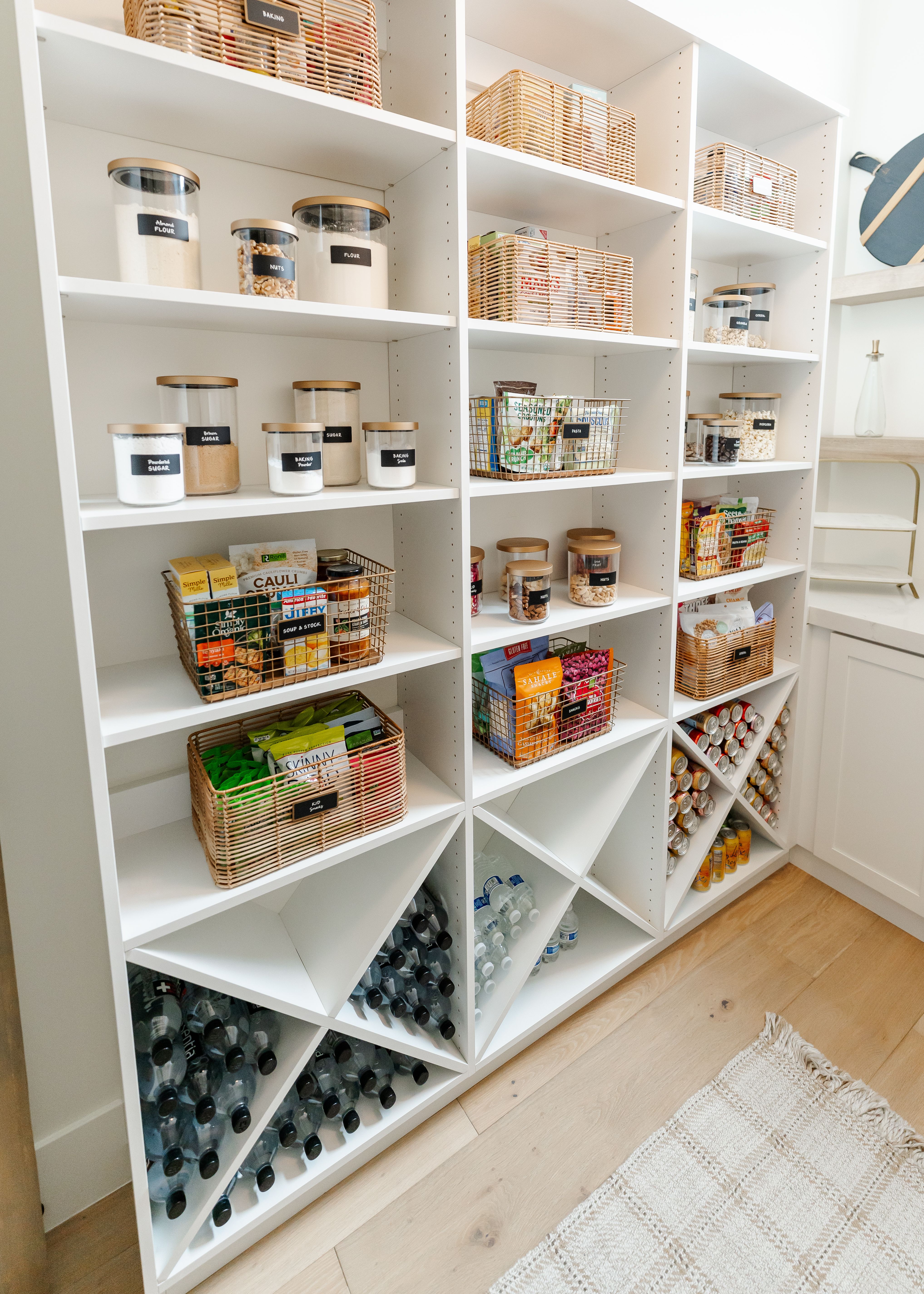
Because food doesn't come in standard heights and what you store changes over time. Cereal boxes, tall oil bottles, and a row of short spice jars all want different spacing, and a fixed shelf set at one height wastes the air above whatever sits on it. Adjustable shelving lets you tighten the gaps so you can see the top of every item instead of stacking things two deep to fill the vertical space.
It also lets the pantry evolve with your household. A family that goes from toddler snacks to teenage cereal consumption, or that starts baking more, can move the shelves without remodeling anything. Every system we build is cut to the actual dimensions of the room, so shelf positions can be planned around what you really store rather than around what a stock kit assumed.
3. Which parts of a pantry should pull out?
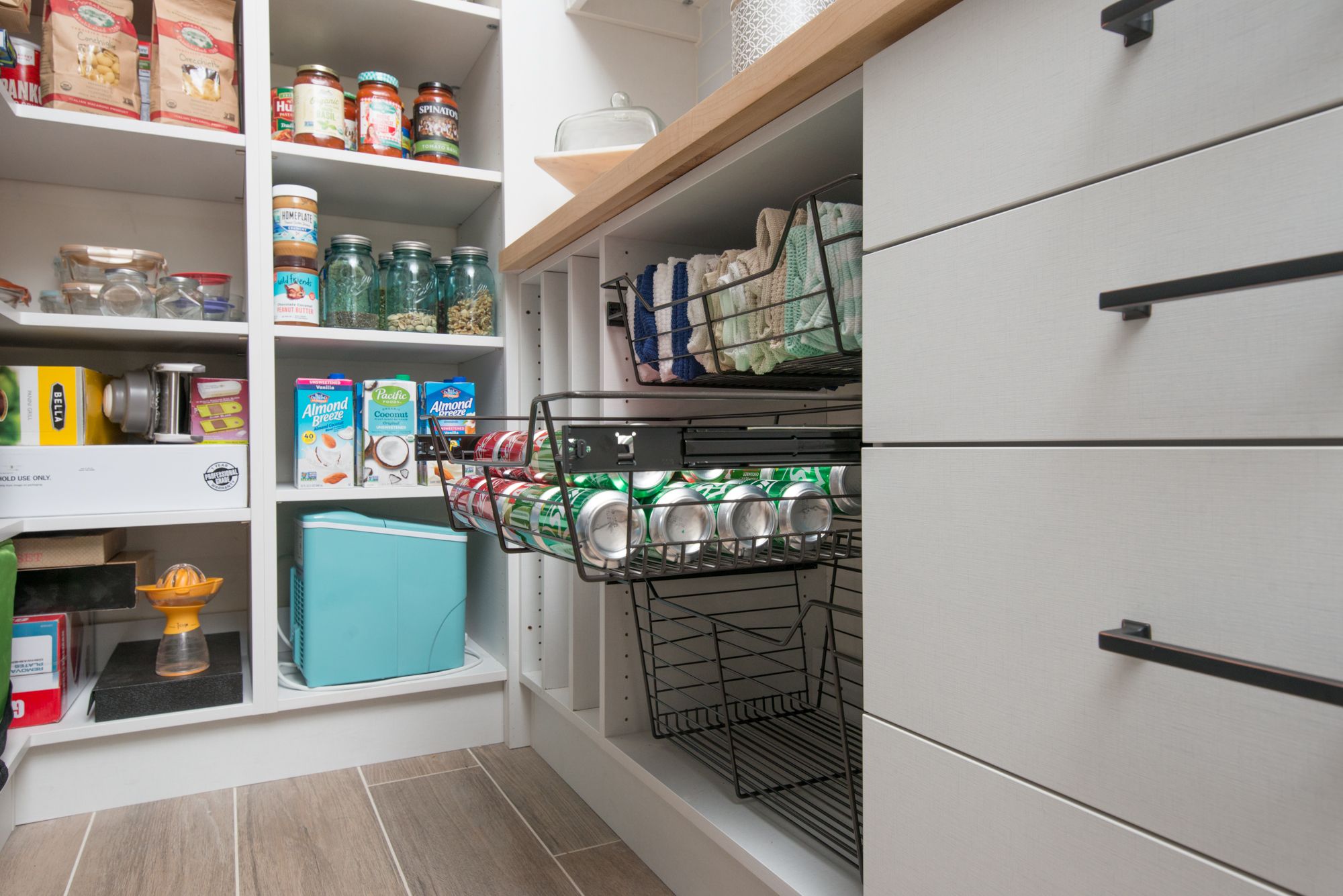
The lower half, nearly always. Anything below hip height is where items get lost, because you have to crouch and then reach to the back, so full-extension drawers or baskets are the third must-have for that zone. A drawer brings the entire contents into view at once, which turns a dark floor shelf into something you can scan in a second. It works especially well for heavy items like canned goods, potatoes, and bottled drinks that are miserable to slide around on a fixed shelf.
The quality of the hardware matters more here than almost anywhere else in the pantry. A loaded drawer of canned tomatoes can weigh well over 50 pounds, and glides that aren't rated for that load will sag and bind within a couple of years.
4. Is the back of the pantry door worth using?
Yes, and it's the most overlooked square footage in the room. The fourth must-have is door-mounted storage, where spices, packets, foil and wraps, or small snacks sit at eye level and come out of the shelf space they would otherwise crowd. Small items are the ones that disappear fastest in a pantry, so giving them a shallow rack where every one is visible solves a problem that shelves alone can't.
A door rack has to be built around the clearances of the door swing and the depth of the shelves beside it, otherwise the door won't close or the rack knocks into the first shelf. That is one reason it works better when it's planned as part of the whole pantry than when it's added afterward.
5. How should you group things so a gap tells you something is missing?
Give every category a permanent zone. The fifth must-have is a layout organized by how you actually cook and eat, with baking supplies together, breakfast items together, snacks at a height the kids can reach, and everyday oils and seasonings near the front. When every category has a home, an empty spot on the shelf reads as "we're out of this" instead of vanishing into a pile of mismatched items.
Zones also make the pantry teachable to everyone in the house. A partner or a teenager can put groceries away correctly without asking, because the pantry itself explains where things go, and that consistency is what keeps the system from drifting over the months after you set it up.
6. Do clear containers and labels really help you track what you're running low on?
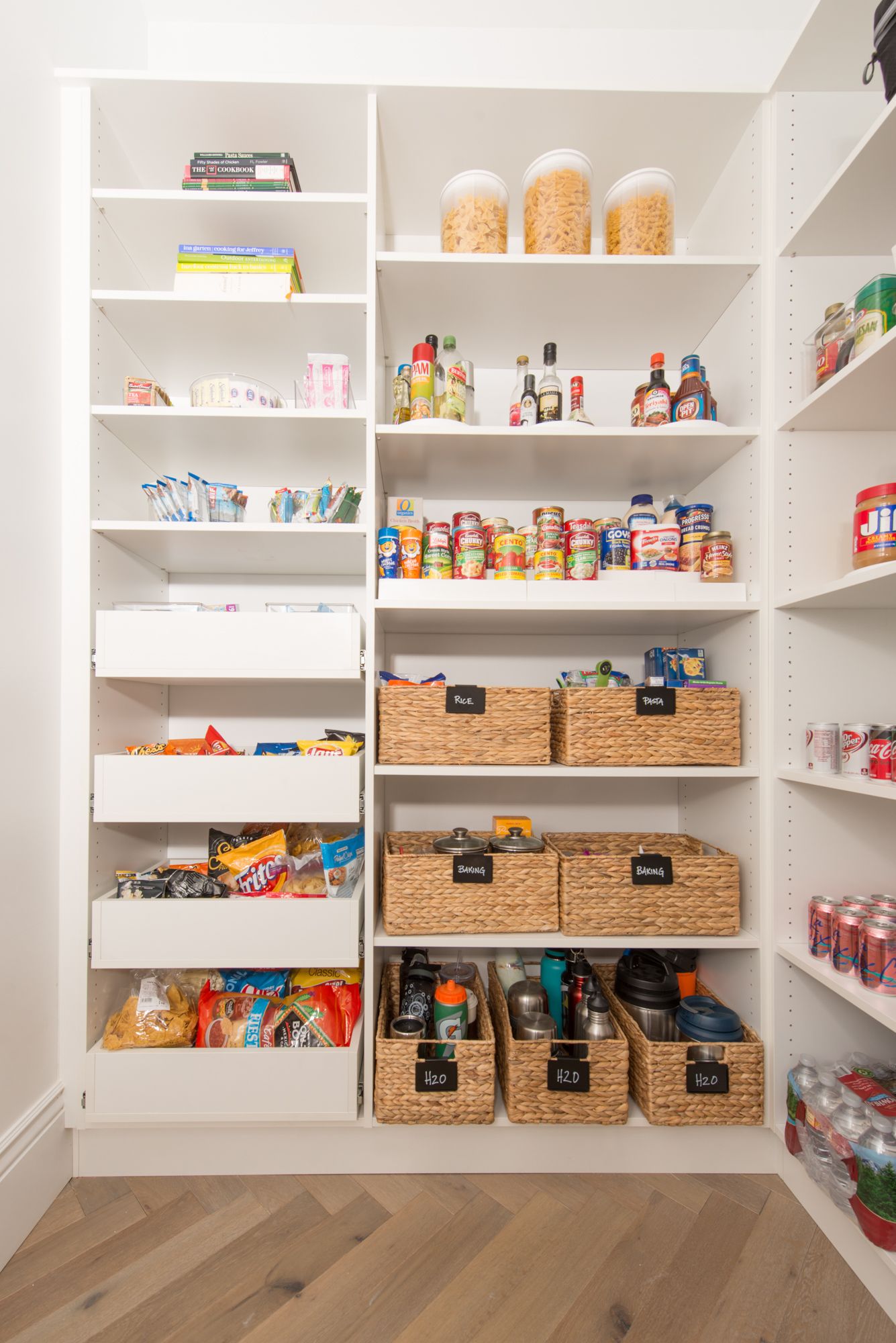
They do, and this is where running-low awareness lives. The sixth must-have is a set of uniform clear containers for dry goods like flour, sugar, rice, and pasta, which lets you see the level in each one without opening it. A label tells everyone in the house what belongs there, and the matching shapes stack cleanly so the shelf reads as a single organized surface rather than a collection of bags in different sizes.
A habit that pairs well with this is keeping one backup of each staple in a consistent spot, so that when the backup moves forward you know it's time to add the item to the list. The shelves and zones make that habit easy to follow, but the containers are what make the inventory visible.
7. Does pantry lighting make a real difference?
It makes a bigger difference than almost any other single upgrade. Most older pantries rely on one ceiling bulb that casts your own shadow onto the shelves, so the lower and back areas stay dim and labels are hard to read. Built-in LED lighting along the shelf edges or vertical uprights lights every level evenly, which means expiration dates are legible without a flashlight and nothing hides in a dark corner.
In a walk-in pantry, motion-activated strips are worth considering so the light comes on as you open the door and you never hunt for a switch with your hands full. The point is the same as everything else on this list: if you can see it, you'll use it before it expires, and you'll notice when it's gone.
8. Where should bulk items go so they don't take over?
Into a zone of their own. Bulk buying is where good pantries fall apart, because a case of sparkling water or a twenty-pound bag of rice has nowhere to live and ends up on the floor or crowding the everyday shelves. The eighth must-have is a dedicated overflow area, usually a low, deep section or a pair of heavy-duty pull-outs reserved for bulk goods.
Giving bulk a boundary also tells you something useful. When that zone is full, you've bought enough, and when it's empty, you know exactly what to restock on the next warehouse trip.
9. Do you need a surface to set groceries on?
You do, and it's the feature people regret skipping most often. The ninth must-have is a landing surface, a counter or a pull-out shelf at roughly waist height, where you can set a grocery bag down and unload it straight onto the shelves. Unloading onto a surface rather than onto the floor is what makes people put things back into their proper zones, because the process is easy enough to do correctly on a tired evening.
In a smaller reach-in pantry, a fold-down or pull-out shelf can do the same job without taking up permanent space. Even a 12-inch-deep ledge near the door changes how the pantry gets used day to day.

10. What should pantry shelves be made of?
A durable, wipe-clean finish with enough thickness to carry weight without bowing. Pantry shelves hold some of the heaviest loads in a house, since a few rows of canned tomatoes or glass jars add up quickly, and thin or unsupported shelves sag in the middle within a year or two. A well-built melamine or laminate surface cleans in seconds when something leaks, and it won't absorb the odor of spilled oil or spice the way bare wood or painted particleboard can.
Wire shelving is the common budget alternative, but small jars tip on it and the grid leaves its pattern on the bottom of every bag. A solid shelf with proper supports gives you a flat, stable surface, which is the whole point of an organized system.
Why build a pantry with Classy Closets instead of buying a kit?
A pantry is one of the places where a kit gets the dimensions wrong, because rooms vary in ways that matter: a slanted ceiling under a staircase, an off-center door, a wall six inches shorter than the one beside it. Classy Closets designs, builds, and installs every system in-house as one team, and nothing is built to stock sizes, so the shelf depths, drawer heights, and zones above are planned for your pantry specifically. The person who measured the room is also the person whose plan gets installed, which prevents most of the on-site surprises that happen when design and installation are split between companies.
That approach has been repeated in a lot of homes, with more than 150,000 completed across the Classy Closets network as a company-wide total. For a remodel or renewal of a pantry you already have, the process is the same: we work with the room you've got, keep what's worth keeping, and rebuild the interior around how your household actually eats.
Bottom Line
The ten must-haves for a pantry are shallow shelves, adjustable heights, pull-outs on the lower levels, door storage, category zones, labeled containers, good lighting, a bulk area, a landing surface, and a durable finish. Every one of them serves the same goal, which is to keep your inventory visible so you can find things quickly and notice what's running out before it matters. When a pantry works that way, the payoff shows up in small daily moments, like starting dinner without a search, shopping from an accurate list, and opening the door to something that looks the same on Friday as it did on Sunday.